TestMasters GMAT Course Syllabus

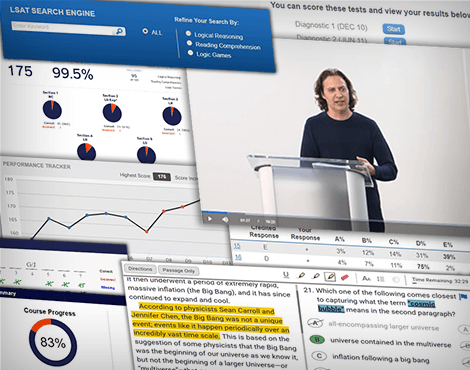
The TestMasters GMAT Course consists of twenty lessons. Each lesson is three hours in length and taught by a live instructor. In addition to the sixty hours of in-class teaching time, students are given extensive homework assignments and seven full-length computer adaptive diagnostic tests. TestMasters students should expect to spend an average of ten to fifteen hours a week preparing for the GMAT outside of class. The course material includes all of the real GMAT questions that appear in the current edition of The Official Guide for GMAT Review. The following syllabus outlines what is covered in each of the twenty lessons of the TestMasters GMAT Course.

Lesson One
  1. Course Introduction
    • The GMAT Scoring Scale
    • Introduction to the CAT Format
    • The CAT Pacing Strategy
  2. Introduction to the Quantitative Section
    • Distribution of Problem Solving and Data Sufficiency Questions Approximating Numbers
    • Approximating Numbers
    • Recognizing Sucker Choices
  3. Basic Math Review
    • Definitions of Key Terms
    • Fractions and Decimals
    • Order of Operations
  4. Introduction to Data Sufficiency
    • The Two/Three Elimination Technique™
Lesson Two
  1. Introduction to the Verbal Section
    • Distribution of Sentence Correction, Critical Reasoning, and Reading Comprehension Questions
  2. Introduction to Sentence Correction
    • Grammatical Errors vs. Stylistic Errors
    • Accelerated Elimination™
    • Capitalizing on Answer Choice Variance
  3. Problem Solving—Algebra
    • Solving Equations
    • Solving Inequalities
    • Transforming Algebra into Arithmetic, Part One
Lesson Three
  1. Data Sufficiency—Algebra
    • Analyzing Equations
  2. Problem Solving
    • Transforming Algebra into Arithmetic, Part Two
    • Must Questions
    • Cannot Questions
  3. Introduction to Critical Reasoning
    • Reacting to the Stimulus
    • Arguments vs. Sets of Facts
    • Identifying Premises and Conclusions
    • The Six Question Types™
Lesson Four
  1. Critical Reasoning
    • Type One Questions
    • Type 1M Questions
  2. Sentence Correction
    • Pronoun Agreement
    • Pronoun Ambiguity
    • The TestMasters Catalog of Idioms
Lesson Five
  1. Problem Solving and Data Sufficiency
    • Translating English into Math
    • Manipulating Complex Word Problems
    • Introduction to Percents
    • The Percent Change Formula
  2. Introduction to Reading Comprehension
    • Categorizing the Passages
    • The Pros and Cons of Outlining
Lesson Six
  1. Critical Reasoning
    • Type Three Questions
    • Cause and Effect Stimuli
  2. Problem Solving
    • Reverse Engineering
  3. Problem Solving—Geometry
    • Angles
    • Quadrilaterals
    • Triangles
    • Perimeter
    • Area
    • The Coordinate Plane
Lesson Seven
  1. Sentence Correction
    • Misplaced Modifiers
    • Parallel Construction
  2. Data Sufficiency—Geometry
    • Analyzing Figures
    • Redrawing Figures
Lesson Eight
  1. Reading Comprehension
    • Political Correctness
  2. Problem Solving and Data Sufficiency
    • Exponents
    • Square Roots
    • Averages
    • Range, Median, and Mode
    • Standard Deviation
Lesson Nine
  1. Critical Reasoning
    • Type Two Questions
    • The 2N Negation Technique™
    • The 2S Justification Technique™
  2. Problem Solving and Data Sufficiency
    • Simultaneous Equations
    • The Rate Matrix™
Lesson Ten
  1. Data Sufficiency
    • The Yes/No Stratagem™
  2. Sentence Correction
    • Verb Tenses, Part One
    • Subject/Verb Agreement
    • Noun Agreement
Lesson Eleven
  1. Problem Solving and Data Sufficiency
    • Ratios and Proportions
    • The Ratio Matrix™
    • The Group Matrix™
  2. Reading Comprehension
    • Business Passages
Lesson Twelve
  1. Critical Reasoning
    • Type Four Questions
    • Type Five Questions
    • Flawed Methods of Reasoning
    • Three-Four Combination Questions
    • Type 5F Questions
  2. Problem Solving and Data Sufficiency
    • Probability
    • Quadratic Equations
Lesson Thirteen
  1. AWA—Analysis of an Issue
    • The Issue Analysis Template™
    • Choosing Compelling Examples
    • Rules of Argumentation
  2. Sentence Correction—Stylistic Errors
    • Active Voice vs. Passive Voice
    • Common Errors in Diction
    • Proper Use of Gerunds
Lesson Fourteen
  1. Problem Solving and Data Sufficiency—Advanced Geometry
    • Circles
    • Overlapping Figures
    • Line Equations
    • Volume
  2. Critical Reasoning
    • Type Six Questions
    • Type Two-Three Combination Questions
Lesson Fifteen
  1. Reading Comprehension
    • Science Passages
  2. Sentence Correction
    • Comparison Words
    • Quantity Words
    • Redundancy
Lesson Sixteen
  1. AWA—Analysis of an Argument
    • Objective Analysis vs. Opinion
    • The Argument Analysis Template—
    • Recognizing Flawed Reasoning
    • Generating Constructive Criticism
  2. Problem Solving
    • Factorials
    • Permutations
    • Combinations
Lesson Seventeen
  1. Problem Solving and Data Sufficiency
    • Patterns
    • Summation
    • Surface Area
    • The Third Side Rule
  2. Reading Comprehension
    • History/Humanities Passages
Lesson Eighteen
  1. Sentence Correction
    • Verb Tenses, Part Two
    • The Subjunctive Mood
  2. Quantitative
    • Scientific Notation
    • Functions
    • Calculating Interest
    • The TestMasters Formula List
Lesson Nineteen
  1. Critical Reasoning Review
  2. Problem Solving Review
Lesson Twenty
  1. Sentence Correction Review
  2. Reading Comprehension Review
  3. Data Sufficiency Review
GMAT is a registered trademark of the Graduate Management Admission Council.

Our company offers services under the name TestMasters everywhere except Texas.
In Texas our company offers services under the name ScorePerfect.

© 1991-2010 TestMasters. All rights reserved.
1620 26th Street · Suite 1000 North
Santa Monica, CA  90404